ComfyUI Cloud Pricing Math: After 40,670 Videos, You Could Have Bought an RTX 4090
ComfyUI Cloud Subscription Plan
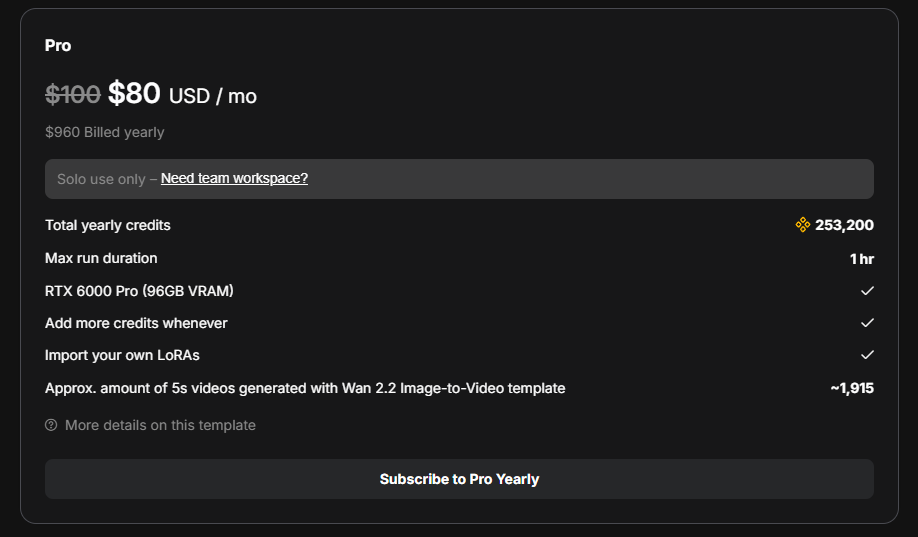
A simple calculation shows us that it costs roughly 4 cents per 5-second video generation using an image-to-video model with ComfyUI's Cloud Plan.
$80 / 1,915 = $0.04177 per video.
That's what one 5-second AI video costs you on ComfyUI's cloud, and that's the generous math. Pro membership, yearly discount applied: $80 per month. That plan covers roughly 1,915 video generations using the Wan 2.2 Image-to-Video template.
Four cents per clip. Sounds like nothing. Cloud pricing always sounds like nothing. That's the entire business model.
So I ran the number the pricing page doesn't want you to run: how many four-cent videos equal one GPU?
The Break-Even Math: ComfyUI Cloud vs. Owning the Hardware
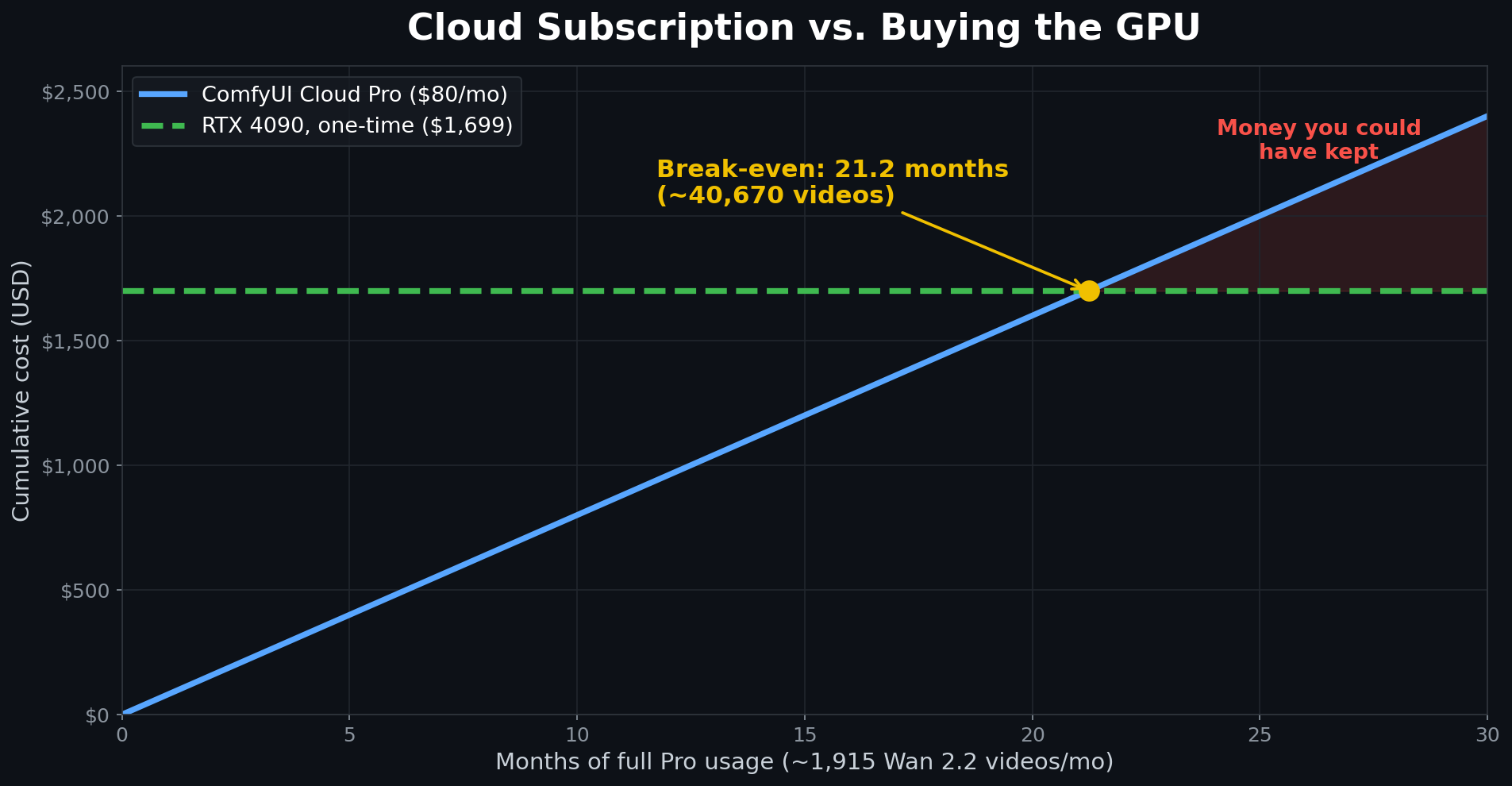
The NVIDIA RTX 4090 launched at $1,699 (March 2023 pricing, before tax and shipping), the card that runs Wan 2.2 image-to-video locally, in your own ComfyUI install, with no meter attached.
$1,699 / $0.04177 per video = 40,670 videos.
That's the line. Generate your 40,671st clip on ComfyUI cloud, and you have officially spent more on subscription fees than the flagship consumer GPU on Earth cost at retail.
And here's the part that should make you sit up: at the Pro plan's ~1,915 videos per month, hitting that number takes just 21.2 months. Use your full allocation, and in under two years you've paid for a 4090 and own nothing.
Some context for what 40,670 five-second videos actually is:
- 56.5 hours of generated footage
- About 64 videos per day, every day, at the plan's monthly cap
- Roughly the output of one moderately busy AI video creator, or one small studio's iteration loop
That's not a hypothetical whale-user workload. If you're storyboarding, iterating on prompts, A/B testing motion, or producing short-form content at any real cadence, you burn through generations fast. Most of what you generate gets thrown away. That's how iteration works. You pay four cents for the keepers and four cents for every miss.
Rent vs. Own: The GPU Edition
This is the oldest financial question there is, wearing a new outfit.
The case for ComfyUI cloud:
- Zero upfront cost. $80/month beats $1,699 + tax on day one.
- No VRAM anxiety. Wan 2.2's larger 14B models are hungry, and the cloud doesn't care.
- No setup. No CUDA versions, no Python environments, no custom node dependency hell.
- Your laptop stays cool and your room stays quiet.
The case for buying the GPU:
- After break-even (~21 months at full usage), every video is effectively free.
- No monthly cap. 1,915 videos is a ceiling; a local 4090 runs as long as you let it.
- The hardware does everything else: gaming, LLM inference, fine-tuning, Stable Diffusion, rendering. The subscription does exactly one thing.
- When you're done, you can sell the card. Used 4090s have held value remarkably well. Try selling 21 months of expired subscription.
The honest caveats, because the math isn't quite that clean:
- Electricity isn't free. A 4090 pulls up to ~450W under load. Heavy daily generation might add $10-20/month to your power bill depending on your rates. That pushes break-even out, but only modestly, nowhere near erasing it.
- Your time isn't free either. Local ComfyUI means installing models, managing workflows, and occasionally debugging a broken custom node at 1 a.m. Some people genuinely should pay to never think about that.
- Cloud hardware is often beefier per-job. Local Wan 2.2 on a 24GB card may mean quantized models or the smaller 5B variant for comfortable headroom. The output gap is shrinking fast, but it exists.
- $1,699 was the 2023 launch price. Street prices have moved both directions since. The break-even point shifts with whatever you'd actually pay today. Run your own number.
None of those caveats change the shape of the curve. They just move the crossover point a few months in either direction. The curve still crosses.
Why Subscription Pricing Always Wins (for the Seller)
Four cents per video is a masterclass in pricing psychology. Nobody anchors on $0.04. Nobody opens a spreadsheet over $0.04. The unit cost is engineered to be below the threshold of thought.
The GPU price works the opposite way: $1,699 is a number you feel. It triggers research, spousal negotiation, three weeks of watching price trackers. Friction is front-loaded on ownership and removed entirely from renting, which is exactly backwards from where the long-run costs sit.
This isn't a ComfyUI-specific criticism. It's every cloud GPU service, every AI image API, every SaaS tool you've quietly paid for 30 months longer than intended. The cloud is a phenomenal deal exactly until the moment your usage becomes consistent, and AI video generation usage, for anyone serious about it, becomes consistent fast.
The Actual Decision Framework
Skip the ideology. Here's the split:
Stay on ComfyUI cloud if:
- You generate fewer than a few hundred videos a month
- You're still deciding whether AI video is part of your workflow at all
- You don't already own a capable PC to host a GPU
- Setup time genuinely costs you more than money
Buy the GPU if:
- You're anywhere near that 1,915/month allocation, regularly
- You'll be doing this for 18+ months (you will, be honest)
- You want the same card to also handle gaming, local LLMs, or training runs
- You'd rather own an appreciating-ish asset than a recurring line item
And if you're in the middle: do what the cloud providers do. Rent until your usage data tells you to buy. The moment your monthly generation count makes the break-even math close within two years, the subscription stops being convenience and starts being interest payments on hardware you'll never own.
The Bottom Line
$80/month feels like nothing. $1,699 feels like a lot. After 40,670 five-second videos, about 21 months of full Pro usage, those two numbers are the same number. Except one of them ends with an RTX 4090 sitting in your case, and the other ends with an email about next month's invoice.
Run your own usage through the math before you renew. The pricing page won't do it for you. That's kind of the point.
Originally published on Medium.